
News
Comparison Between Trailer Concrete Pumps and Boom Pumps
In modern construction, the concrete pump is an essential piece of equipment for improving pouring efficiency. As engineering requirements diversify, concrete pumps are mainly divided into two major types: Trailer Concrete Pumps and Boom Pumps (Truck-Mounted Concrete Pumps). Each type offers unique advantages, and choosing the right one is crucial for project success. The following detailed comparison will help you make the right decision.
Product Overview
Trailer Concrete Pump
A trailer concrete pump is typically powered by a diesel engine or electric motor. It delivers concrete to the pouring point through connected pipelines. It is towed to the jobsite by a truck or vehicle and features a simple structure, lower cost, and easier maintenance.
Trailer pumps are widely used in: foundation works, tunnels, bridges, urban underground projects, rural construction, and high-rise pumping tasks.
Boom Pump (Concrete Pump Truck)
A boom pump is installed on a truck chassis and equipped with a hydraulic telescopic boom (commonly 28 m – 63 m). The pump continuously delivers concrete through its pipelines directly to the desired pouring point.
It does not require additional placing equipment and is ideal for bridges, elevated roads, large-scale concrete pours, and projects with tight construction schedules.
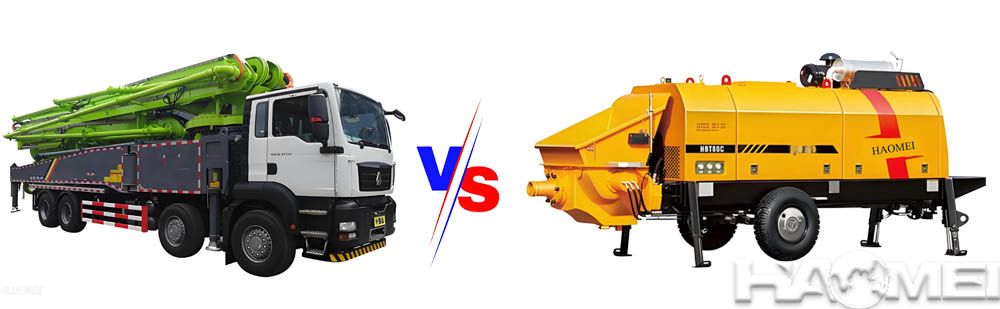
Trailer Concrete Pump VS Boom Pump
1. Efficiency
Boom Pump:
Offers much higher construction efficiency. The boom delivers concrete directly and precisely, making it suitable for large-scale continuous pours.
Trailer Pump:
Requires manual pipe laying, which reduces operational efficiency. However, it excels in long-distance pumping and in confined areas where vehicle-mounted pumps cannot operate.
2. Construction Flexibility
Trailer Pump:
Smaller size and easier mobility. Additional pipelines allow extremely long-distance pumping. Ideal for narrow roads, congested jobsites, and complex terrain.
Boom Pump:
The boom provides excellent pouring flexibility, but the truck chassis requires spacious, flat jobsite conditions.
3. Cost
Trailer Pump:
Lower equipment cost, moderate maintenance expense, and overall lower operating cost. It is more suitable for budget-limited or medium-scale projects.
Boom Pump:
Both purchase and operating costs are higher. However, its high productivity significantly reduces total construction time and overall project cost.
4. Pumping Distance
Trailer Pump:
Can achieve hundreds of meters of vertical or horizontal pumping through extended pipelines. Ideal for ultra-high-rise buildings or long-distance delivery.
Boom Pump:
Limited by boom length (typically 20-70 meters). Best suited for low-rise or mid-rise buildings and large-area pours.
5. Labor Cost
Boom Pump:
Higher automation level and requires fewer workers.
Trailer Pump:
Requires additional labor for pipe laying, fixing, and cleaning, resulting in higher manpower requirements and labor intensity.
6.Application Areas
Trailer-mounted concrete pumps are suitable for small to medium-sized projects, scattered construction sites, foundation pouring, and confined spaces.
Concrete pumps are suitable for mid- to high-rise buildings, large-scale continuous pouring projects (bridges, shopping malls), and construction sites requiring efficient concrete placement.
Conclusion
Boom Pump (Pump Truck)
The ideal choice when high efficiency, automated operation, and rapid concrete placement are required. It is the main equipment for most medium and large urban construction projects.
Trailer Pump (Ground Pump)
The best solution for extreme pumping distances, high-rise vertical delivery, narrow sites, or when controlling equipment cost is essential. It delivers excellent flexibility for complex and specialized projects.
How to Choose the Right Concrete Pumping Equipment?
Below are the key factors to consider:
1. Building Height
Horizontal distance over 300 m or vertical height over 70 m:
A boom pump cannot meet these requirements. A trailer pump with high-pressure pipelines is required.
Vertical height within 50 m with a large horizontal coverage area:
A boom pump is the best choice, as it can cover the entire pouring zone without long pipeline setups.
2. Concrete Volume Requirements
Large volumes with tight deadlines (e.g., large foundation slabs, main structures):
Choose a boom pump for its superior automation and continuous delivery capability.
Moderate or intermittent concrete pouring:
A trailer pump is more cost-efficient while still meeting performance needs.
3. Jobsite Conditions
Narrow entrances, limited movement space, or soft ground:
Trailer pump is more suitable.
Open and spacious jobsite:
A boom pump can operate freely and efficiently.
4. Budget Considerations
This includes not only equipment purchase or rental cost but also total project cost involving manpower, management, and construction duration.