
News
Hot Products
Recent Posts
Energy-Efficient LB1500 Asphalt Mixing Plant for Bridge Deck Paving
Concrete Batching Plants for Large-Scale Infrastructure Projects in Saudi Arabia
Concrete two-bin / three-bin batching machine
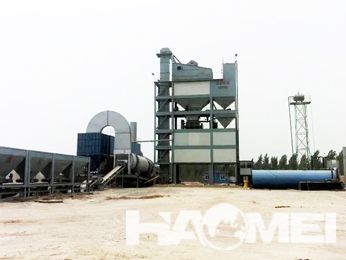
Asphalt mixing plant structure
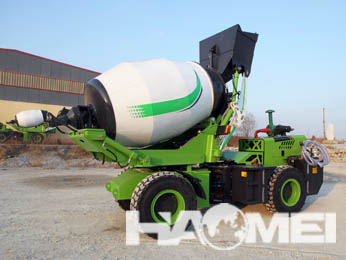
Self-Loading Concrete Mixer Truck: "One Vehicle, Multiple Uses"
Trailer Concrete Pump for Building Construction
In modern building construction, concrete placement often needs to be continuous, stable, and adaptable to changing site conditions. A trailer concrete pump is widely used for foundations, columns, shear walls, slabs, underground structures, and medium to high-rise building projects where ready-mixed concrete must be transported through pipelines to the pouring location.
From the perspective of equipment manufacturing, the value of a trailer pump is not only in pumping concrete, but also in matching the hydraulic system, pumping unit, control system, wear parts, and pipeline layout to the actual construction environment. Proper selection and operation can improve pouring continuity, reduce manual handling, and support safer site organization.
Role of Trailer Concrete Pumps in Building Construction
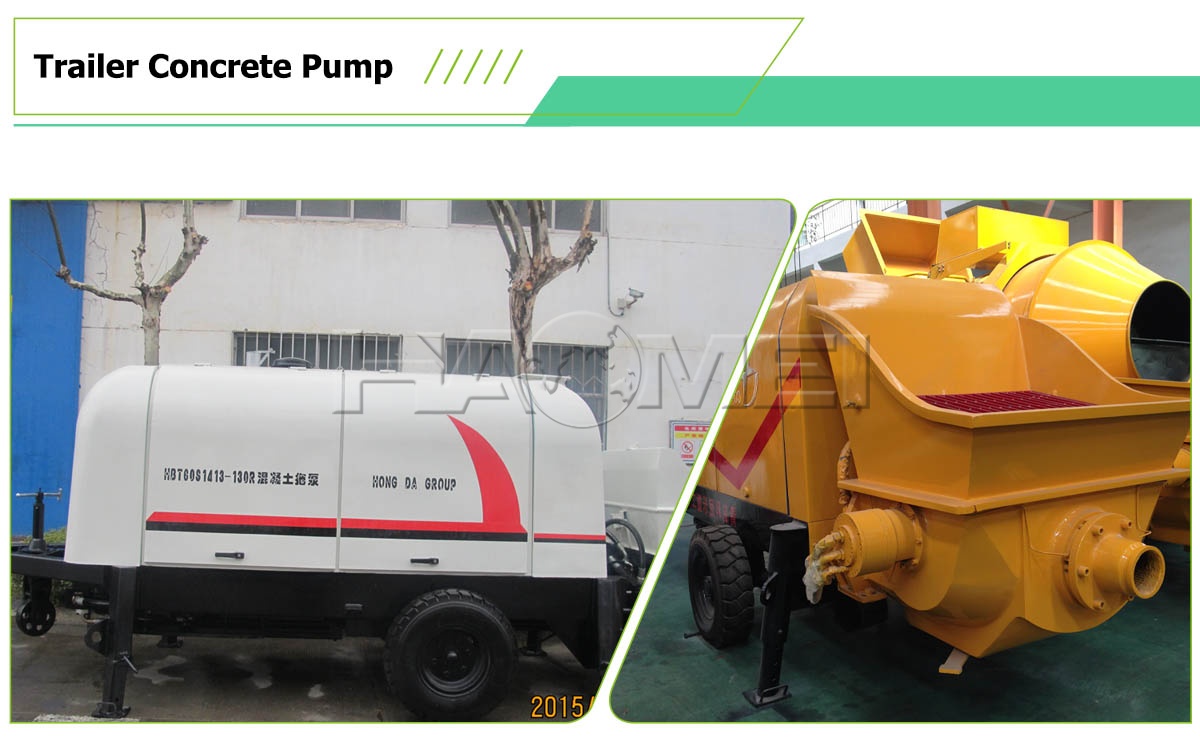
A trailer concrete pump, also known as a stationary concrete pump, is usually placed at ground level or a stable working area. Concrete is discharged from a mixer truck or batching plant into the hopper, then pushed through delivery pipelines to the required construction position.
Compared with manual transportation or short-distance mechanical transfer, a trailer pump is suitable for projects where concrete must be delivered horizontally, vertically, or through complex site routes. For contractors, the key concern is not only the theoretical output, but also whether the pump can maintain stable pressure, handle the designed concrete mix, and work reliably under project conditions.
For building projects requiring flexible concrete delivery, a Trailer Concrete Pump can be configured according to site power supply, pumping distance, aggregate size, concrete slump, and project schedule.
Main Structure and Working Principle
A trailer concrete pump is generally composed of a power system, hydraulic system, pumping system, hopper and mixing device, distribution valve, electrical control system, lubrication system, and chassis. The pumping process is based on the reciprocating movement of concrete cylinders and the switching action of the distribution valve.
When one concrete cylinder draws concrete from the hopper, the other cylinder pushes concrete into the delivery pipeline. The distribution valve alternately connects the concrete cylinders with the hopper and pipeline, enabling continuous concrete delivery.
| Main Component | Function in Operation | Manufacturing Focus |
|---|---|---|
| Power system | Provides driving power for the hydraulic system | Engine or motor matching, fuel or power efficiency, maintenance accessibility |
| Hydraulic system | Drives concrete cylinders, valve switching, and auxiliary actions | Pressure stability, oil temperature control, sealing reliability |
| Concrete cylinders | Complete suction and discharge cycles | Wear resistance, sealing performance, smooth reciprocating motion |
| Distribution valve | Controls concrete flow direction between hopper and pipeline | Switching accuracy, wear part durability, anti-blocking performance |
| Hopper and mixer | Receives concrete and keeps material evenly mixed before pumping | Hopper capacity, mixing blade design, cleaning convenience |
| Electrical control system | Manages operation, monitoring, and protection functions | Clear interface, safety interlocks, fault indication |
| Lubrication system | Reduces wear on key friction parts | Stable lubrication supply and convenient maintenance |
| Trailer chassis | Supports movement and positioning on site | Structural strength, towing convenience, stabilizing design |
Application Scenarios in Building Construction
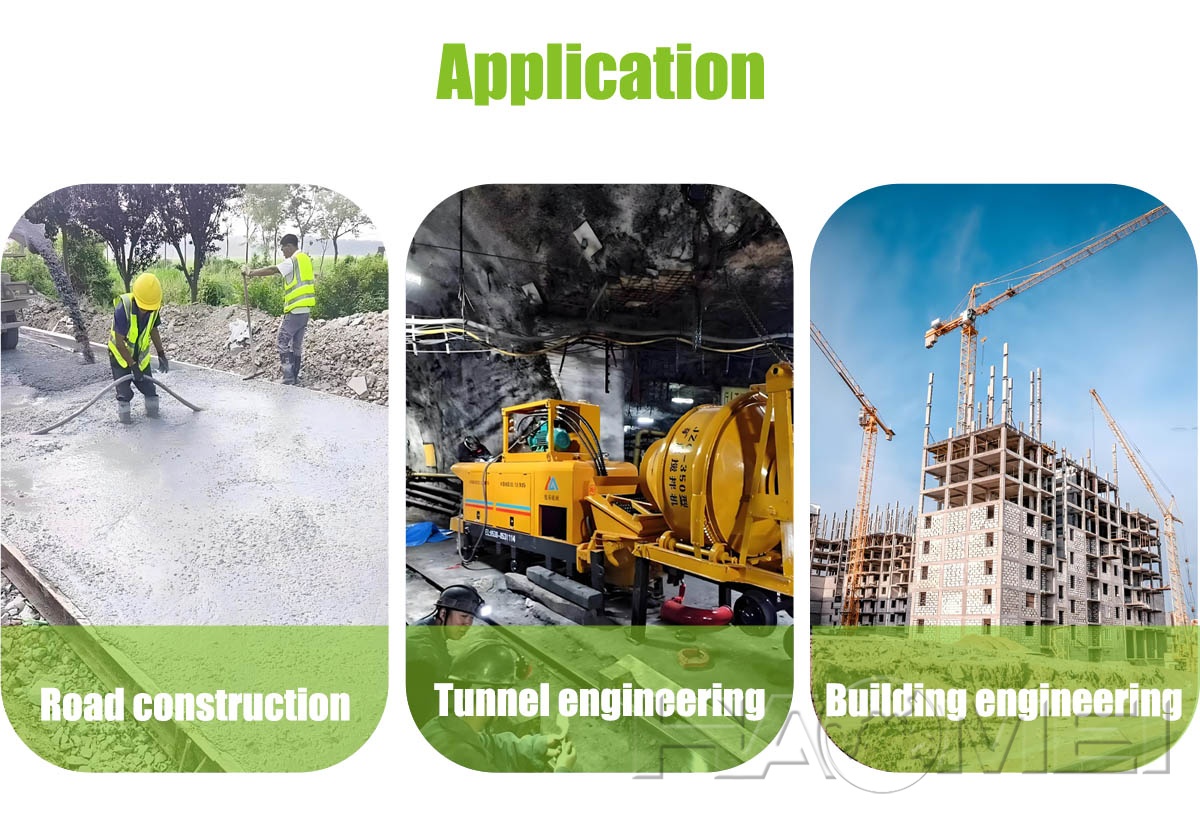
Trailer concrete pumps are used in many stages of building construction. The actual model selection should consider the construction height, horizontal distance, pipeline bends, concrete grade, aggregate size, and pouring rhythm.
| Building Construction Scenario | Typical Pumping Task | Equipment Selection Considerations |
|---|---|---|
| Foundation works | Raft foundations, pile caps, basement slabs | Stable output, good suction performance, continuous delivery capability |
| Structural frame construction | Columns, beams, slabs, and shear walls | Vertical pumping pressure, pipeline layout, concrete workability |
| Underground construction | Basements, retaining walls, underground passages | Compact site arrangement, reliable hopper feeding, easy cleaning |
| Renovation or limited-access sites | Concrete delivery where mixer trucks cannot reach the pouring point | Flexible pipeline routing, suitable power configuration, safe positioning |
| Commercial and residential buildings | Repeated floor-by-floor concrete placement | Consistent performance, convenient maintenance, wear part availability |
Configuration Options for Different Site Requirements
As a manufacturer, configuration design is usually based on engineering conditions rather than a single specification. Different projects may require diesel-powered, electric-powered, or high-pressure configurations. The selected pump should match both the concrete mix and the delivery route.
| Configuration Item | Common Options | Selection Guidance |
|---|---|---|
| Power type | Diesel engine or electric motor | Diesel is suitable for sites with unstable power supply; electric type is suitable where grid power is available |
| Pumping pressure | Standard or higher pressure configuration | Higher pressure may be needed for long-distance or vertical pumping, subject to pipeline design |
| Distribution valve | S-valve or other applicable valve structure | Selected according to concrete characteristics and maintenance preference |
| Control mode | Manual, wired remote, or control panel operation | Should support safe operation and clear status monitoring |
| Lubrication method | Manual or automatic lubrication | Automatic lubrication helps reduce maintenance uncertainty on frequent-use sites |
| Cooling system | Air cooling or water cooling depending on design | Selected according to ambient temperature and operating intensity |
| Pipeline accessories | Straight pipes, elbows, reducers, hoses, clamps | Must match pumping pressure and site layout requirements |
For projects requiring balanced output and practical site adaptability, models such as the HBT60S1413-112R Trailer Concrete Pump are typically evaluated according to concrete mix design, delivery distance, and working environment before final selection.
Key Factors Affecting Pumping Performance
Pumping performance is influenced by more than the machine itself. Concrete quality, pipeline design, operator method, and maintenance all affect the stability of concrete delivery.
| Factor | Influence on Pumping | Practical Recommendation |
|---|---|---|
| Concrete slump | Affects flowability and suction efficiency | Keep the mix within the project-specified range and avoid unauthorized water addition |
| Aggregate size and gradation | Affects pipe blockage risk and pumping resistance | Use aggregate suitable for the pipe diameter and pump design |
| Pipeline layout | Long distance, height, and bends increase resistance | Reduce unnecessary bends and use proper pipe supports |
| Pipe diameter | Influences concrete flow speed and pressure loss | Select pipe size according to output, aggregate, and delivery distance |
| Lubrication before pumping | Reduces initial friction inside the pipeline | Use suitable mortar or priming material before concrete delivery |
| Wear parts condition | Affects pressure holding and delivery efficiency | Inspect wear plates, cutting rings, seals, and pistons regularly |
| Operator coordination | Impacts continuous feeding and safe pumping | Maintain communication among pump operator, mixer truck driver, and placing crew |
Manufacturing Considerations for Reliable Building-Site Operation
For building construction, a trailer concrete pump often works under long operating hours, uneven ground conditions, and frequent pipeline adjustments. Therefore, manufacturing design should focus on structural strength, hydraulic stability, maintainability, and safety protection.
Important design considerations include:
Rigid frame structure to support stable pumping during high-load operation.
Wear-resistant concrete flow components to reduce frequent replacement.
Hydraulic circuit design that supports smooth cylinder reversing and stable pressure.
Hopper grille and emergency stop devices for operator safety.
Accessible maintenance points for lubrication, filter replacement, and inspection.
Clear control panel layout for easier operation and troubleshooting.
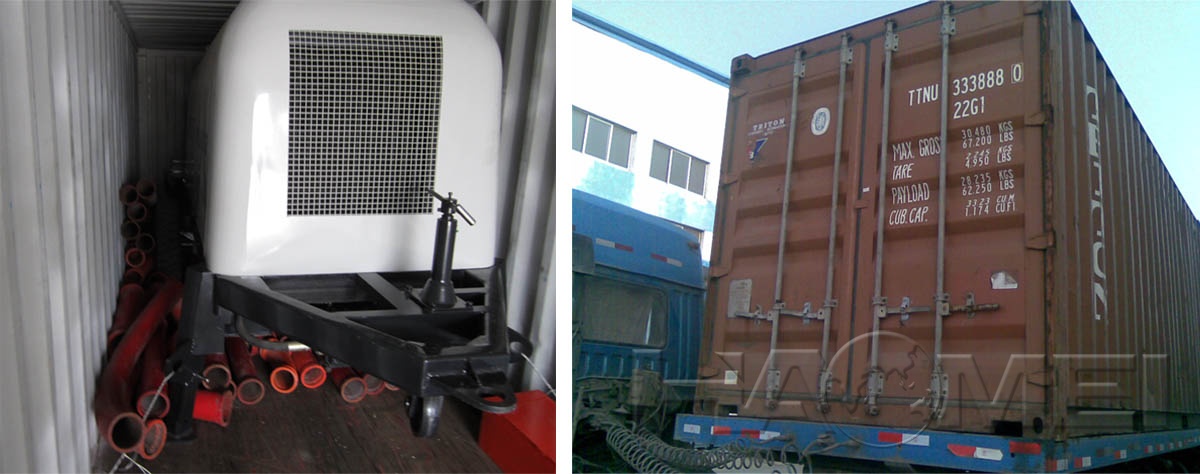
Operation and Maintenance Notes
Correct operation is essential for extending equipment service life and reducing unplanned downtime. Before pumping, the operator should inspect the hydraulic oil level, lubrication system, pipe clamps, delivery pipeline, hopper, wear parts, and electrical connections. During pumping, the hopper should maintain enough concrete to prevent air suction into the pipeline.
| Stage | Inspection or Operation Item | Purpose |
|---|---|---|
| Before pumping | Check hydraulic oil, lubrication points, pipe clamps, and hopper condition | Prevent leakage, dry friction, and unsafe pipe connection |
| Priming stage | Lubricate the pipeline with suitable mortar or priming material | Reduce starting resistance and blockage risk |
| During pumping | Maintain continuous feeding and observe pressure changes | Keep pumping stable and identify abnormal resistance early |
| Temporary stop | Reverse pump briefly when necessary and prevent concrete setting in pipes | Reduce blockage risk during short interruptions |
| After pumping | Clean hopper, cylinders, and delivery pipeline thoroughly | Prevent hardened concrete from damaging components |
| Routine maintenance | Inspect wear plates, cutting rings, pistons, seals, filters, and bolts | Maintain pumping efficiency and operational safety |
Industry Trends in Trailer Concrete Pump Development
Building construction is moving toward higher efficiency, better site management, and more standardized concrete quality control. Trailer concrete pump technology is also developing in several directions.
| Trend | Impact on Equipment Design |
|---|---|
| Energy-conscious construction | Encourages optimized hydraulic systems and power matching |
| Smarter operation monitoring | Supports fault reminders, working status display, and easier maintenance planning |
| Improved wear resistance | Reduces downtime in projects with frequent concrete pumping tasks |
| Compact site adaptability | Requires better layout flexibility for urban and limited-access construction sites |
| Safer operation requirements | Promotes enhanced protection devices, emergency controls, and clearer operation interfaces |
Conclusion
A trailer concrete pump is an important concrete conveying machine for building construction, especially where concrete must be delivered over distance, height, or restricted site routes. Its performance depends on machine design, configuration selection, concrete quality, pipeline arrangement, and daily maintenance.
For manufacturers, the core objective is to provide equipment that matches real engineering requirements with stable hydraulic performance, durable pumping components, practical control systems, and convenient maintenance. For construction users, correct model selection and standardized operation remain the foundation for efficient and reliable concrete placement.