
News
Sicoma Twin-Shaft Concrete Mixer for Infrastructure Construction
Infrastructure projects place demanding requirements on concrete production equipment. Roads, bridges, tunnels, rail systems, water conservancy works, and precast facilities may require different concrete grades, aggregate sizes, admixture systems, and production schedules. A Sicoma twin-shaft concrete mixer is commonly selected for these applications because its forced mixing principle supports consistent material circulation within the mixing chamber.
As a construction machinery manufacturer, equipment selection is evaluated from the perspective of mix design compatibility, batching plant layout, maintainability, and project operating conditions rather than output alone. The mixer should match the concrete recipe, aggregate grading, planned production rhythm, and maintenance resources available at the jobsite or stationary plant.
Why Infrastructure Concrete Requires Controlled Mixing
Infrastructure concrete often needs stable workability and uniform distribution of cementitious materials, water, aggregates, and admixtures. Depending on the project, the mix may include manufactured sand, larger coarse aggregates, fly ash, slag powder, fibers, or water-reducing admixtures. These material combinations require a mixer that can create effective circulation while maintaining a practical inspection and wear-part replacement process.
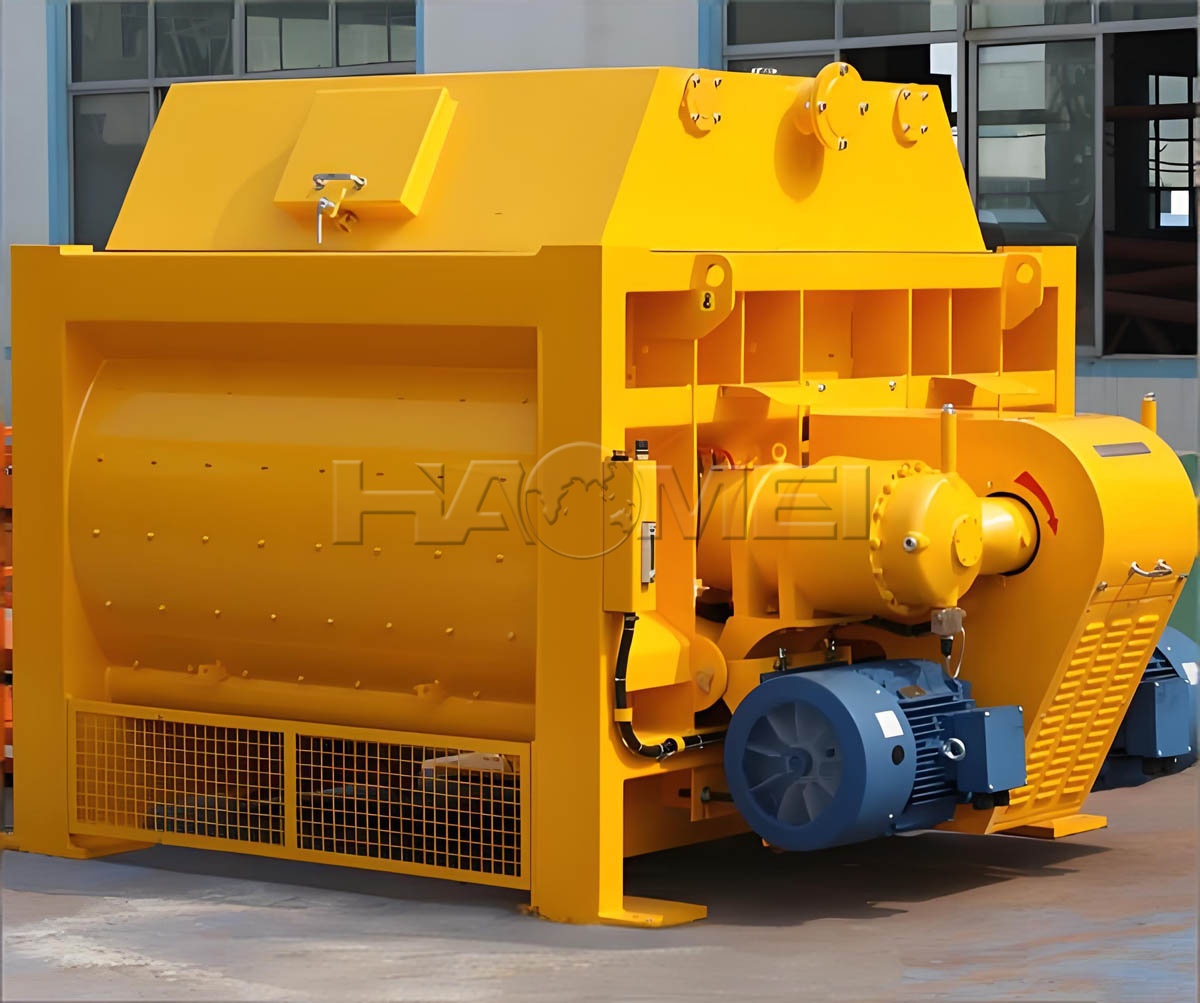
A twin-shaft forced mixer uses two horizontal mixing shafts fitted with mixing arms and blades. During operation, the shafts rotate in opposite directions, moving materials through intersecting mixing paths. This movement helps reduce localized material accumulation and promotes a more uniform blend before discharge.
| Infrastructure Requirement | Mixer-Related Consideration | Engineering Purpose |
|---|---|---|
| Multiple concrete grades | Repeatable mixing cycle control | Supports organized production changes between mix designs |
| Variable aggregate grading | Suitable blade, arm, and liner arrangement | Helps manage material flow and wear exposure |
| Admixture-based mixes | Accurate water and admixture dosing coordination | Supports mix consistency across batches |
| Continuous plant operation | Accessible inspection and maintenance points | Reduces time required for routine servicing |
| Remote or temporary sites | Adaptable batching plant integration | Supports installation within mobile or stationary plant layouts |
Performance Advantages of SICOMA Twin-Shaft Concrete Mixers
1.Uniform Mixing: The twin-shaft forced mixing design ensures rapid and thorough blending of cement, aggregates, water, and admixtures, enhancing concrete uniformity.
2.High Production Efficiency: Suitable for continuous, high-volume concrete production, meeting the demands of infrastructure projects such as roads, bridges, tunnels, and water conservancy works.
3.Strong Adaptability: Capable of handling various concrete types and mix ratios, including standard, dry-hard, and high-performance concrete.
4.Excellent Wear Resistance: Mixing arms, blades, and liners feature wear-resistant designs, making them ideal for environments involving hard aggregates and high-frequency operation.
5.Rapid Discharge: The efficient discharge mechanism shortens batch cycle times and boosts the overall operational efficiency of the mixing plant.
6.Stable Operation: Key drive components feature mature designs, ensuring reliability during the prolonged, high-intensity continuous operations required for infrastructure projects.
7.Easy Maintenance: Wear parts are easily accessible for inspection and replacement, reducing maintenance downtime and long-term operating costs.
8.High Compatibility: Compatible with HZS-series concrete mixing plants and automated batching systems, making it suitable for concrete production lines in large-scale projects.
Working Principle of a Sicoma Twin-Shaft Concrete Mixer
The main mixing process begins after aggregates, cementitious materials, water, and admixtures are introduced into the mixer. The counter-rotating shafts drive the mixing arms and blades, creating a three-dimensional material movement inside the chamber. Materials are lifted, folded, sheared, and redistributed until the programmed mixing cycle is complete.
The discharge gate then opens to release the finished concrete into a transit mixer, concrete pump hopper, bucket, or downstream conveying system. For batching plant applications, discharge timing should be coordinated with the weighing system, truck loading sequence, and concrete delivery schedule.
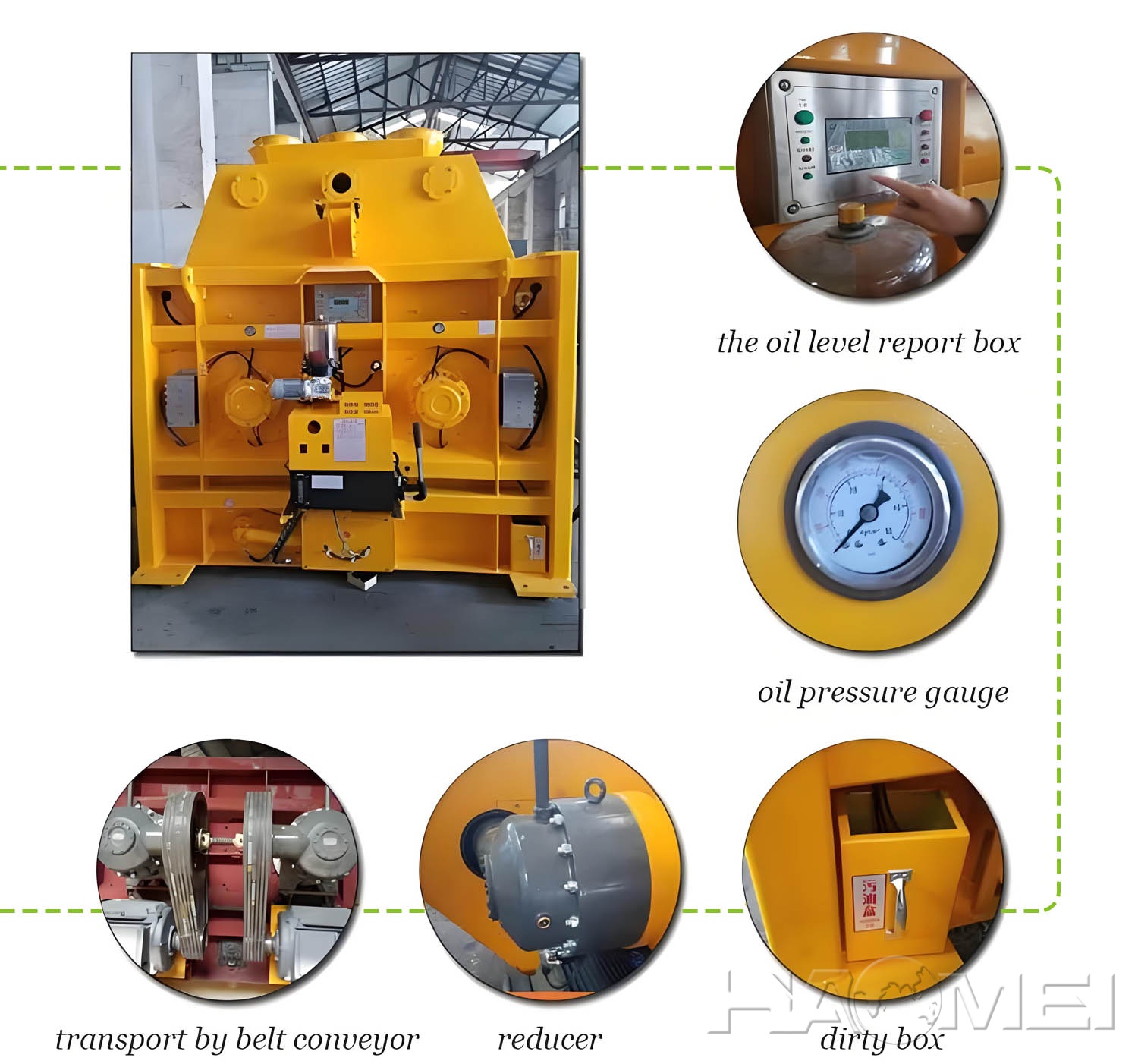
| Main Component | Primary Function | Maintenance Focus |
|---|---|---|
| Mixing chamber | Contains the concrete mixing process | Check liners and internal buildup |
| Twin shafts | Transfer rotational force to mixing tools | Inspect seals, bearings, and alignment |
| Mixing arms and blades | Move and shear concrete materials | Monitor wear and adjust or replace as required |
| Drive system | Powers shaft rotation | Check gearbox condition, couplings, and lubrication |
| Discharge gate | Releases mixed concrete | Inspect sealing surfaces and actuator operation |
| Lubrication system | Supplies grease to designated points | Maintain scheduled lubrication intervals |
| Control interface | Coordinates batching and mixing cycles | Verify settings, sensors, and interlocks |
Configuration Considerations for Infrastructure Batching Plants
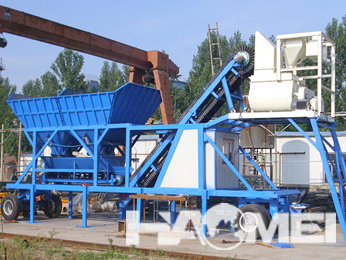
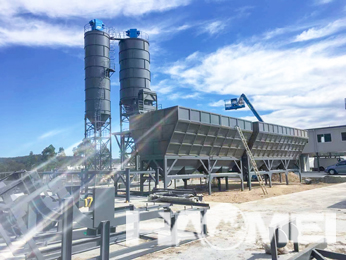
A Sicoma twin-shaft concrete mixer can be specified as part of a complete concrete batching plant or integrated into an existing production line where mechanical and electrical interfaces are suitable. Configuration decisions should be based on the actual engineering application rather than selecting equipment solely by nominal mixer size.
Important selection factors include batch volume, aggregate maximum size, concrete type, expected operating hours, local power conditions, discharge height, and required automation level. Wear protection and maintenance access are particularly relevant where abrasive aggregates or long production cycles are expected.
| Configuration Item | Available Direction | Application Consideration |
|---|---|---|
| Mixer capacity class | Selected according to batch demand | Should align with plant output planning and truck dispatch rhythm |
| Wear liners | Standard or enhanced wear-resistant arrangements | Consider for abrasive aggregates and high-frequency production |
| Discharge arrangement | Standard gate and compatible discharge interface | Must match receiving hopper, truck, belt, or skip layout |
| Lubrication | Manual or centralized lubrication solutions | Centralized systems can simplify recurring service tasks |
| Control integration | Standalone or batching plant control connection | Requires coordination with weighing and dosing systems |
| Cleaning provisions | Water piping and washout planning | Supports end-of-shift cleaning and internal inspection |
For compact projects and smaller batching systems, a JS1000 Concrete Mixer may be considered where the batch requirement, aggregate condition, and plant arrangement are suitable. For larger centralized production layouts, mixer selection should be reviewed together with aggregate storage, weighing equipment, truck loading capacity, and concrete delivery distance.
Typical Infrastructure Applications
Twin-shaft forced mixers are used in a wide range of infrastructure-related concrete production scenarios. The required configuration can differ significantly between temporary site plants and permanent commercial or precast operations.
| Application Scenario | Typical Concrete Requirement | Equipment Planning Focus |
|---|---|---|
| Highway and pavement works | Stable consistency for paving or structural sections | Production continuity and aggregate handling coordination |
| Bridge construction | Structural concrete with controlled mix proportions | Accurate dosing and reliable batch traceability |
| Tunnel projects | Concrete for linings, support works, or ancillary structures | Plant footprint, material logistics, and cleaning management |
| Railway construction | Foundations, drainage, and supporting structures | Flexible production scheduling for multiple concrete grades |
| Water conservancy works | Mass concrete or structural concrete applications | Material storage planning and temperature-related process control |
| Precast yards | Repeated production of standardized elements | Consistent batching sequence and mold production coordination |
A properly configured Sicoma Concrete Mixer can be integrated with aggregate batching machines, cement silos, screw conveyors, weighing systems, and plant controls to form a coordinated concrete production system. The final configuration should be confirmed against the project specification and local operating conditions.

Maintenance Practices That Support Service Life
Mixer reliability depends on installation quality, operating discipline, and planned maintenance. Concrete residue should not be allowed to build up inside the mixing chamber, as hardened material can affect mixing movement, increase component stress, and complicate later cleaning.
Routine inspection should focus on wear parts, shaft-end seals, lubrication points, fasteners, discharge gate movement, and drive-system condition. Any abnormal noise, vibration, leakage, or change in discharge behavior should be checked promptly by trained personnel.
| Maintenance Item | Recommended Check | Reason |
|---|---|---|
| Mixing blades and arms | Inspect wear and secure fastening | Maintains designed material movement |
| Chamber liners | Check thickness and attachment condition | Protects the mixer body from abrasion |
| Shaft-end seals | Inspect for leakage and abnormal wear | Helps protect bearing and shaft-end assemblies |
| Gearbox and drive unit | Follow lubrication and inspection requirements | Supports stable power transmission |
| Discharge gate | Check opening, closing, and sealing condition | Helps avoid incomplete or delayed discharge |
| Electrical controls | Test interlocks and operating signals | Supports safe and coordinated plant operation |
Selection Approach for Project Owners and Contractors
The most suitable mixer is not always the largest unit. A practical selection process begins with the expected concrete volume per shift, target batching rhythm, aggregate characteristics, mix designs, transport method, and available maintenance capability. Site layout and future expansion requirements should also be considered before finalizing the batching plant arrangement.
Factory technical review normally includes the relationship between mixer capacity, aggregate batching capacity, cement supply, weighing accuracy, plant control system, and concrete delivery equipment. This system-level approach helps avoid bottlenecks caused by mismatched equipment capacities.
Conclusion
A Sicoma twin-shaft concrete mixer is a relevant solution for infrastructure concrete production where controlled forced mixing, configuration flexibility, and maintainable equipment design are required. Its value in a batching plant depends on selecting an appropriate configuration, matching it to the concrete mix design, and following disciplined operation and maintenance procedures.
For infrastructure contractors, ready-mix producers, and project managers, mixer selection should be treated as part of the complete concrete production process. Careful evaluation of materials, plant layout, production requirements, and service planning supports a more practical and reliable equipment decision.