News
Long-Distance Trailer Concrete Pump
During the construction of the 828-meter Burj Khalifa in Dubai, concrete had to be pumped to a height of 606 meters. In the deep canyons of Guizhou, China, bridge construction required horizontal pumping over 2,000 meters. Challenges that appear impossible can be fully achieved by a trailer-mounted concrete pump. This equipment integrates powerful pumping capacity, stable performance, and convenient mobility, ensuring uninterrupted concrete placement even under complex terrain and long-distance horizontal or vertical conveying conditions.
Introduction
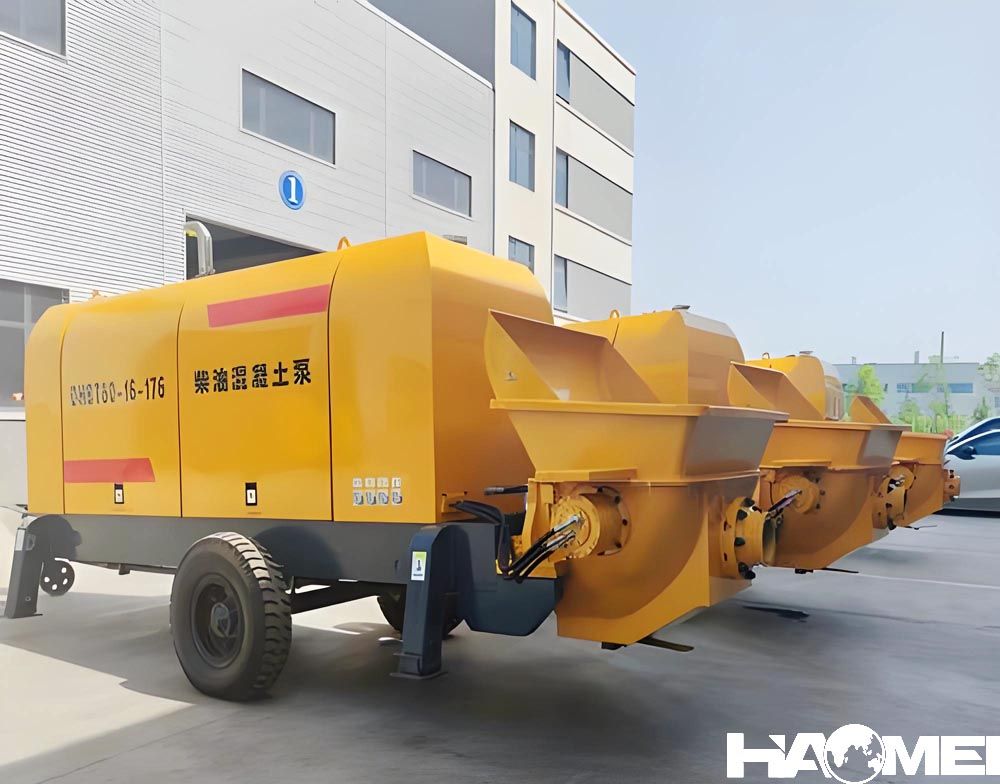
A long-distance trailer concrete pump is a high-pressure concrete conveying machine designed to transport fresh concrete through steel pipes or rubber hoses over long distances. Unlike truck-mounted boom pumps, the trailer pump features a compact structure and lightweight design, making it easy to transport using a towing vehicle. Its greatest advantage lies in its high-pressure hydraulic system, enabling concrete to be pumped horizontally for several hundred meters and vertically to considerable heights.
HAOMEI's HBT series trailer-mounted concrete pumps deliver horizontal conveying distances of 2,000-4,000 meters and vertical pumping heights of 500-800 meters. Available models include HBT60, HBT80, HBT90, with theoretical outputs ranging from 80-150 m³/h.
Irreplaceable Advantages of Trailer-Mounted Concrete Pumps
1. Exceptional Pumping Performance
This is the core value of a trailer pump. Through staged pressurization and optimized pipeline configuration, the pump can deliver concrete to the top floors of skyscrapers or deep inside mountain tunnels.
2. Compact and Mobile Transport Design
The unit can be quickly moved between different job sites by towing, making it ideal for small-batch and multi-site construction work without requiring complex installation or stabilization procedures.
3. Intelligent Control System
Equipped with automatic diagnostics, automatic adjustment, and blockage pre-warning functions, the system can adjust pumping pressure and frequency in real time to minimize downtime.
4. Easy Maintenance and Repair
The relatively simple structure and accessible components, such as the hydraulic system and pipeline-make inspections and replacement easier, reducing maintenance time and complexity.
5. Lower Investment Cost
Compared with truck-mounted pumps or boom pumps, trailer pumps are more cost-effective, suitable for budget-constrained projects.
6. Environmentally Friendly Design
Energy consumption is 20-30% lower than using multiple relay pumps, with reduced dust and noise emissions.
Applications of Trailer Concrete Pumps
1. High-Rise Building Construction
Trailer pumps can deliver concrete directly to upper floors without relying on boom trucks.
2. Large-Scale Infrastructure Projects
Dams, bridges, and highway tunnels often require long-distance concrete pumping in areas where vehicle access is limited.
3. Remote or Hard-to-Reach Areas
Pipeline pumping is ideal for mountainous regions or deep foundation pits.
4. Urban Construction with Restricted Access
Trailer pumps perform efficiently in narrow or crowded construction sites.
Technical Performance
| Maximum theoretical output | 60-120 m³/h |
| Maximum pumping pressure | 12-22 MPa |
| Maximum horizontal conveying distance | 600-1500 m |
| Maximum vertical pumping height | 120-300 m |
| Power type | Diesel engine or electric motor |
| Main valve type | S-valve or gate valve |
| Hopper capacity | 600-800 L |
Trailer Pump vs. Truck-Mounted Pump
Mobility:
Truck-mounted pumps feature an integrated chassis and can drive directly to the job site, offering greater mobility. Trailer pumps require towing but have lower transport costs.
Construction Efficiency:
Truck-mounted boom pumps automatically deploy their booms for pipe layout, reducing manual labor. Trailer pumps require manual pipeline installation but offer excellent pumping continuity.
Application Scenarios:
Trailer pumps are better suited for fixed or semi-fixed sites such as tunnels and bridges, whereas truck-mounted pumps are ideal for urban building projects requiring frequent relocation.
Maintenance Guidelines for Trailer-Mounted Concrete Pumps
Pipeline Selection:
Use high-pressure, wear-resistant double-layer or triple-layer pipes with specialized high-strength couplings.
Pipeline Layout Principles:
Minimize bends; where unavoidable, use large-radius wear-resistant elbows to reduce conveying resistance and localized abrasion.
Cleaning and Maintenance:
After each pumping operation, thoroughly clean the pipeline using water, air compression, or foam balls to prevent hardened concrete build-up that may cause blockages.