
News
Sicoma Concrete Mixer for Bridge Construction
Bridge construction requires stable concrete quality across foundations, piers, girders, deck slabs, and precast components. Mix consistency is especially important where projects use high-strength concrete, low water-to-binder ratio mixes, large aggregate, mineral admixtures, or controlled workability specifications. A Sicoma concrete mixer is commonly considered for these applications because its twin-shaft forced-mixing principle is suited to demanding concrete production processes.
As a construction equipment manufacturer, equipment selection is evaluated according to concrete mix design, required output, batching plant arrangement, aggregate grading, maintenance access, and the operating conditions of the bridge project. The mixer should be specified as part of the complete production system rather than as an isolated machine.
Concrete Production Requirements in Bridge Projects
Bridge works often involve several concrete grades and placement methods within one project. For example, substructure concrete may prioritize durability and mass-pour temperature control, while precast girders and deck elements may require closely controlled strength development and surface quality. The mixing system must support repeatable production under these changing requirements.
| Bridge application | Typical concrete production concern | Mixer selection consideration |
|---|---|---|
| Pile caps and foundations | Large-volume pours and durable mixes | Batch capacity, aggregate handling, reliable discharge |
| Piers and columns | Consistent workability and placement continuity | Uniform mixing, batching accuracy, discharge coordination |
| Precast girders and segments | Strength consistency and controlled low-slump mixes | Intensive mixing action, repeatable cycle management |
| Bridge deck concrete | Workability retention and surface finish | Admixture addition sequence, mixing time control |
| Site-cast beams and culverts | Variable aggregate and project-specific mix designs | Wear protection, adaptable configuration, easy cleaning |
Twin-Shaft Mixing Principle
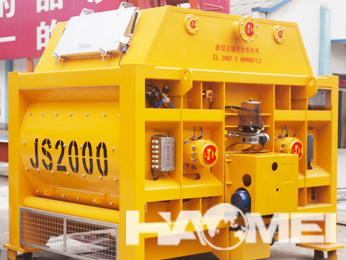
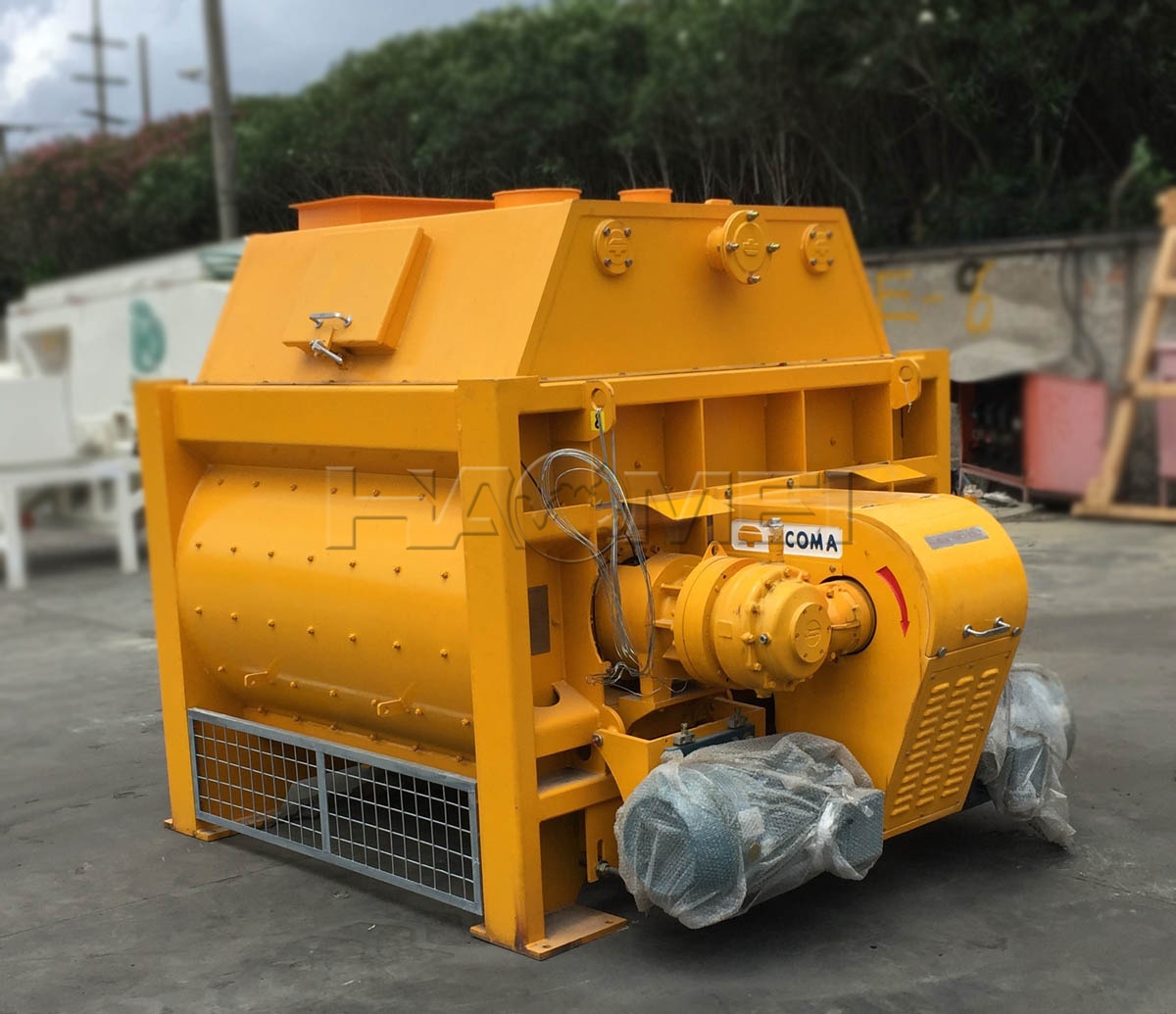
A Sicoma concrete mixer for bridge construction typically uses a twin-shaft forced-mixing arrangement. Two horizontal shafts fitted with mixing arms and paddles rotate within the mixing chamber. Their overlapping mixing zones move aggregates, cementitious materials, water, and admixtures through the batch, helping reduce localized material concentration.
The mixing process depends not only on the mixer structure but also on the batching sequence. Aggregate loading order, water dosage, admixture timing, mixing duration, and discharge timing should be established through trial mixes and the project concrete specification. For bridge concrete, the operating team should avoid extending mixing time without a technical basis, as the correct cycle depends on material properties and desired fresh-concrete performance.
Main Equipment Structure and Functional Components
The configuration of a twin-shaft mixer should match the abrasiveness of aggregates, production frequency, and maintenance plan. Key components are summarized below.
| Component | Primary function | Bridge project consideration |
|---|---|---|
| Mixing chamber | Contains and guides material during mixing | Wear-resistant liners should be selected according to aggregate hardness and production intensity |
| Twin mixing shafts | Drive the forced-mixing action | Shaft alignment and bearing condition affect long-term operating stability |
| Mixing arms and paddles | Move and blend materials through the chamber | Paddle layout and replacement access are important for low-slump and abrasive mixes |
| Drive system | Transfers motor power to the shafts | Motor and transmission configuration should suit the required batch cycle and site power conditions |
| Discharge gate | Releases mixed concrete to the receiving hopper or truck | Gate sealing and opening control influence clean discharge and residual-material control |
| Lubrication system | Supports lubrication of specified moving parts | Centralized or automatic lubrication can simplify routine servicing where appropriate |
| Control interface | Coordinates batching, mixing, and discharge steps | Integration with the batching plant control system supports recipe management and traceability |
Integration With a Bridge Concrete Batching Plant
For bridge construction, a mixer performs best when integrated with correctly sized aggregate bins, weighing systems, cement silos, water meters, admixture tanks, conveyors, and control software. The batching plant layout should also account for truck access, concrete delivery distance, cleaning water management, and maintenance space.
A Sicoma Concrete Mixer can be incorporated into stationary, modular, or project-specific batching plant arrangements. The final configuration should be determined by required hourly production, batch size, material storage capacity, transport method, and the bridge construction schedule.
| System item | Configuration objective | Practical note |
|---|---|---|
| Aggregate batching | Accurate proportioning of sand and graded stone | Separate bins help manage multiple aggregate sizes used in bridge mix designs |
| Cement and supplementary materials | Stable feeding and weighing | Silo capacity and screw conveyor arrangement should match consumption and delivery logistics |
| Water and admixture dosing | Controlled liquid addition | Metering equipment should be calibrated and protected from site contamination |
| Mixer discharge | Efficient transfer to truck, hopper, or bucket | Discharge height and receiving equipment must be coordinated during plant design |
| Plant control system | Recipe execution and production records | Batch data can support quality management and troubleshooting procedures |

Selecting Mixer Capacity for the Project
Mixer capacity should not be chosen only by a nominal output target. The effective production rate is influenced by the actual batch volume, loading time, mixing time, discharge time, truck turnaround, concrete transport distance, and daily production schedule. When bridge projects require several concrete grades, the time required for cleaning and changing recipes should also be considered.
| Selection factor | Questions for project planning |
|---|---|
| Required daily volume | What is the planned peak concrete demand for foundations, piers, girders, or deck pours? |
| Pouring method | Will concrete be delivered by transit mixer, pump, crane bucket, or precast distribution system? |
| Mix characteristics | Does the mix contain large aggregate, fibers, supplementary cementitious materials, or low-slump proportions? |
| Plant location | Is the batching plant positioned near the bridge site, a precast yard, or a remote material source? |
| Maintenance plan | Are spare wear parts, inspection access, and scheduled servicing included in site planning? |
For smaller supporting works or auxiliary concrete production, a JS1000 Concrete Mixer may also be evaluated according to the required batch volume and plant design. Selection should be based on the engineering requirement and verified production planning rather than model name alone.
Operation and Maintenance Considerations
Bridge projects frequently operate under tight construction schedules, so routine inspections are necessary to reduce unplanned downtime. Maintenance personnel should follow the equipment manual and the site safety procedure for all inspection, cleaning, lubrication, and replacement work.
Recommended maintenance attention points include:
Inspect mixing paddles, arms, liners, and fasteners for wear at scheduled intervals.
Check shaft seals, lubrication points, reducers, and drive components according to the maintenance plan.
Remove residual concrete after production and avoid buildup around the discharge gate.
Verify weighing and dosing equipment calibration as part of concrete quality control.
Keep records of wear-part replacement, abnormal vibration, motor load changes, and repair actions.
Confirm that lockout and isolation procedures are followed before entering or servicing the mixing chamber.
Industry Direction: Quality Control and Flexible Plant Design
Bridge infrastructure projects increasingly emphasize traceable batching, durable concrete design, efficient material management, and reduced production interruptions. In response, concrete mixing systems are commonly specified with improved automation interfaces, maintenance-oriented structural details, configurable wear protection, and compatibility with project-level batching control systems.
The appropriate Sicoma concrete mixer configuration depends on the actual bridge design, local material conditions, concrete specification, production schedule, and service resources. A technical review covering mix trials, plant layout, power supply, delivery logistics, and maintenance access provides a more reliable basis for equipment selection.
Conclusion
A Sicoma concrete mixer can serve as a core mixing unit in bridge concrete batching plants and precast bridge production lines. Its twin-shaft forced-mixing structure supports the production of a range of concrete mixes when matched with suitable batching equipment, process controls, and maintenance procedures. For bridge construction, the most effective solution is a coordinated system designed around the project's concrete demand and quality-control requirements.